


Updated: June 2026. | Next review: December 2026.
You do not need to understand how AI works. You need to understand how to use it, and what it means when it gets things wrong.
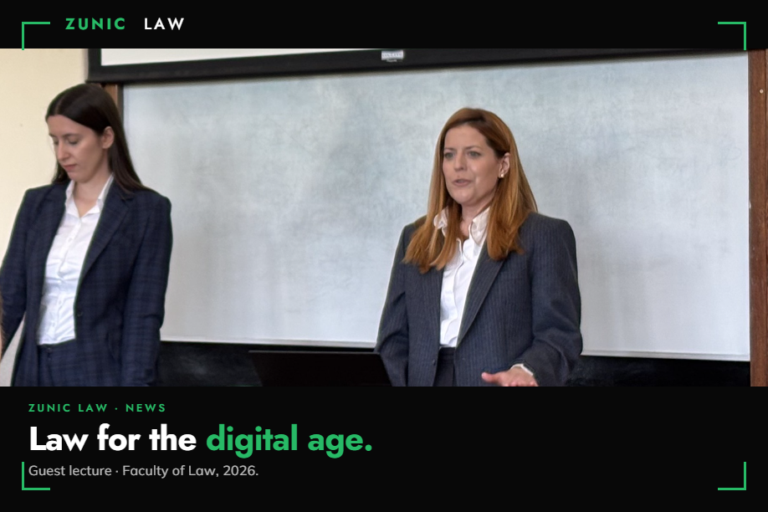
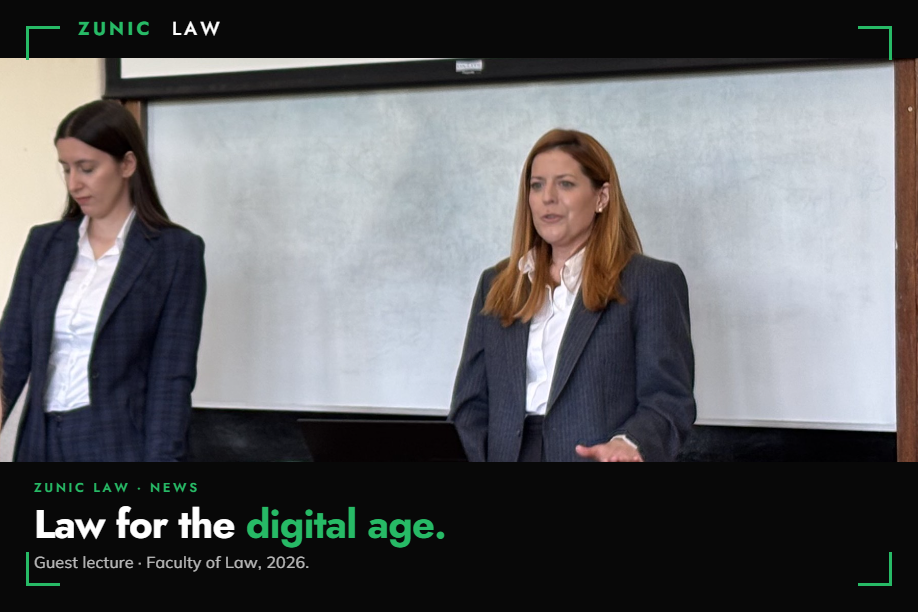
This post grew out of a guest workshop we delivered at the Faculty of Law, University of Belgrade, at the invitation of Prof. Dr Mirjana Drenovak-Ivanović, as part of her Legal Tech course. The students in the room made the most of it: questions came throughout the entire session, we ran over time, and no one complained.
Afterwards we were left with a neatly written list of questions the students had asked. Not theoretical questions, but practical ones: what do I do when I run out of my daily limit, will my professor know I used AI, how safe is it for my data.
Those questions reveal what students already know, and what they do not. That is more useful than any syllabus. These five points cover what comes up most often, and what matters most to know before you even start using the tools.
Note: You will notice that Claude is mentioned more often than other tools in what follows. The reason is practical: Claude is the tool we use as our primary at Zunic Law, and we are speaking from that experience. Most of the principles we describe, especially around writing prompts, checking accuracy, and organising work, apply equally to ChatGPT, Gemini, and other platforms. We have no business or sponsorship relationship with any of the platforms mentioned. All recommendations are based solely on personal experience of using them.
Contents
- The prompt is the most important skill you can learn today
- AI hallucinates, and it is your responsibility to verify
- The free version is enough
- ChatGPT is not the only tool, and is not always the right choice
- Law students are studying at exactly the right moment for this topic
- Frequently asked questions
- Instead of a conclusion
1. The prompt is the most important skill you can learn today
The most common mistake students make when they first use AI is to ask a question as if they were using a search engine. "EU AI Act obligations." "Employment contract analysis." And then they are disappointed with the result.
AI assistants are not search engines. They respond to what you tell them, from the perspective you give them, in the format you specify. If you specify none of those things, you get an average.
There are four components of a good prompt. Role tells Claude how to approach the task: "act as an experienced lawyer explaining to students." Defining the role correctly immediately changes the tone and depth of the response Claude will give. Task is what you want, as precisely as possible. Not "write a text," but "write a 200-word introduction for a seminar paper, formal tone, topic is data protection." Context gives Claude information about your situation: what year of study you are in, which subject, how many words you need. Format is an explicit request: "structure as an introduction, three arguments, and a conclusion; no bullet points; academic style."
You do not need to use all four components in every conversation, but each component you add narrows the response. The difference is like between "bring me something to eat" and "bring me a cheese sandwich, no tomato, warm." The second request is easier to fulfil.
2. AI hallucinates, and it is your responsibility to verify
This is one of the most important things we tell students, and one of the few that is uncomfortable to say.
LLM models are trained to predict the next most likely token in a sequence, not to return accurate information. Those two things are the same in most cases. They are not always.
ChatGPT, Claude, Gemini, they all hallucinate. Sometimes they cite a case number that does not exist but sounds convincing. Sometimes they quote a statutory provision that was never part of that act. Sometimes they invent authors in a bibliography. They do this confidently and without any caveat.
This is not a reason to avoid AI, but a reminder to use it with understanding. Claude is excellent for structure, formulating arguments, proofreading, preparing drafts, summarising long documents. It is not reliable as the sole source of legal references.
Practical rule: anything Claude states about a specific act, judgment, provision, or date, verify in the original source. Propisi.gov.rs, EUR-Lex, case law databases. AI can point you in the right direction. Finding it is your job.
3. The free version is enough
When we tell students to start using Claude, the first question is always: how much does it cost?
It is free, with no trial period that expires.
On the free plan you get access to the Sonnet model, which is a capable model, not a weakened version. You can upload PDF documents and images. You can use Projects, folders where you store context for different subjects. You can configure Memory so that Claude remembers who you are, which writing style you prefer, and which language you work in.
The only limitation is the daily message count, which is sufficient for normal student work. If you use up your limit on a long task, there is a simple workaround: ask Claude to write a short summary of the conversation, copy it, and continue in a new chat with that summary as context. That way the conversation continues without losing the thread.
The Pro plan makes sense for intensive professional use. For students, the free plan covers everything needed.
4. ChatGPT is not the only tool, and is not always the right choice
Most students who start working with AI tools use ChatGPT exclusively, because it was first and because it is the most widespread. That is a reasonable starting point. But it is not the only option, and it is not always the best choice.
There are several platforms relevant to legal work. Claude from Anthropic is the tool we use as our primary at Zunic Law. It is focused on accuracy and working with long documents, and has significant capacity, meaning it can process an entire contract or judgment at once. Gemini from Google is directly integrated with Google Workspace tools. If you work in Google Docs or Gmail, Gemini will be there. Perplexity is an AI search engine that provides sources in real time alongside every answer, making it useful for research work where you want to see where information comes from.
Each of these tools has a free version. It makes sense to try more than one and see which fits the way you work.
5. Law students are studying at exactly the right moment for this topic
We are not saying this out of enthusiasm for technology. We are saying it because it is true.
The EU AI Act has started to apply. Data protection law has been in force for years. Corporate law for tech companies, labour law for hybrid working models, IP law for generative AI, these are all areas where demand is growing for lawyers who understand both sides.
At Zunic Law we are actively looking for such lawyers. Our experience is that the profile of "lawyer who understands AI" is rare and that firms operating in that space are struggling to find it. Students who start now, who learn how the tools work and how law intersects with regulation, are building a step ahead.
That does not mean you need to become technologists. It means you need to understand what AI can do, what it cannot do, and what the law says about it. All three can be learned during your studies, without any special technical background.
Frequently asked questions
Will my professor know I used AI for my seminar paper?
It depends on how you wrote it and whether you reviewed the generated text. AI tools leave patterns in writing that experienced readers recognise: uniform sentence length, certain transitional phrases, structure without clarity. If you used AI as a base and did not edit the text, it is likely visible. The recommendation is to use AI for structure and drafts, but to make the final text your own. Before that, check the rules of your faculty and the specific course regarding the permitted or prohibited use of AI tools when writing papers.
Which AI tool is best for law students?
For general use and working with documents, Claude is a good starting point because of its focus on accuracy and the ability to upload long documents. For research work where you want to see sources alongside the answer, Perplexity is useful. For integration with Google Workspace, Gemini. There is no single answer that applies to everyone, it depends on the task.
Is it legal to use AI for writing papers?
At the level of Serbian law there is no general prohibition. At the level of academic institutions the rules vary, and most are still developing. The recommendation is to check the internal rules of your faculty, programme, or course and to be explicit with your professor if you use AI. Transparency is a simpler defence than a later explanation.
Where can I find specific prompts for legal research?
Anthropic has launched the Claude for Legal programme with free resources: tested prompts for case briefing, legal research, writing memoranda, and contract analysis. It is available on GitHub, searching "claude-for-legal github" leads to the repository. Completely free, for all students.
What is the EU AI Act and what does it mean for the legal profession?
The EU AI Act is a European Union regulation that classifies AI systems according to risk level and imposes obligations on companies that develop or use them. For lawyers this means two things: clients who develop and/or use AI systems will acquire new obligations, and firms that use AI in their work must understand those obligations. Zunic Law actively deals with this regulation both in the context of the firm's own work and in advising clients.
Instead of a conclusion
AI will not replace lawyers. That sentence has been repeated so many times it has become background noise. A more useful question is: which lawyers will it not replace?
The answer we see in practice: those who understand what the tool does, when to trust it, and when to verify. That is not technical knowledge. That is professional judgement.
Start. Open a project for one subject and try one prompt. There is no better way to learn than to see what you get.
Follow us at @zuniclaw on Instagram and LinkedIn. For news about AI in law, opportunities for young lawyers, and updates from Zunic Law, sign up for our Candidate Newsletter.
About the authors
Author
Nada Matković, HR & Talent Manager | Zunic Law
Nada Matković is HR & Talent Manager at Zunic Law, where she is responsible for team development, recruitment, and the Zunic Elevate programme of continuous professional development. She works on the topic of AI in work and education.
Author
Marija Veselinović, Attorney-at-Law | Zunic Law
Marija Veselinović is an attorney at Zunic Law, specialised in IT law, data protection, and AI regulation. She advises clients in the areas of GDPR and the EU AI Act.